

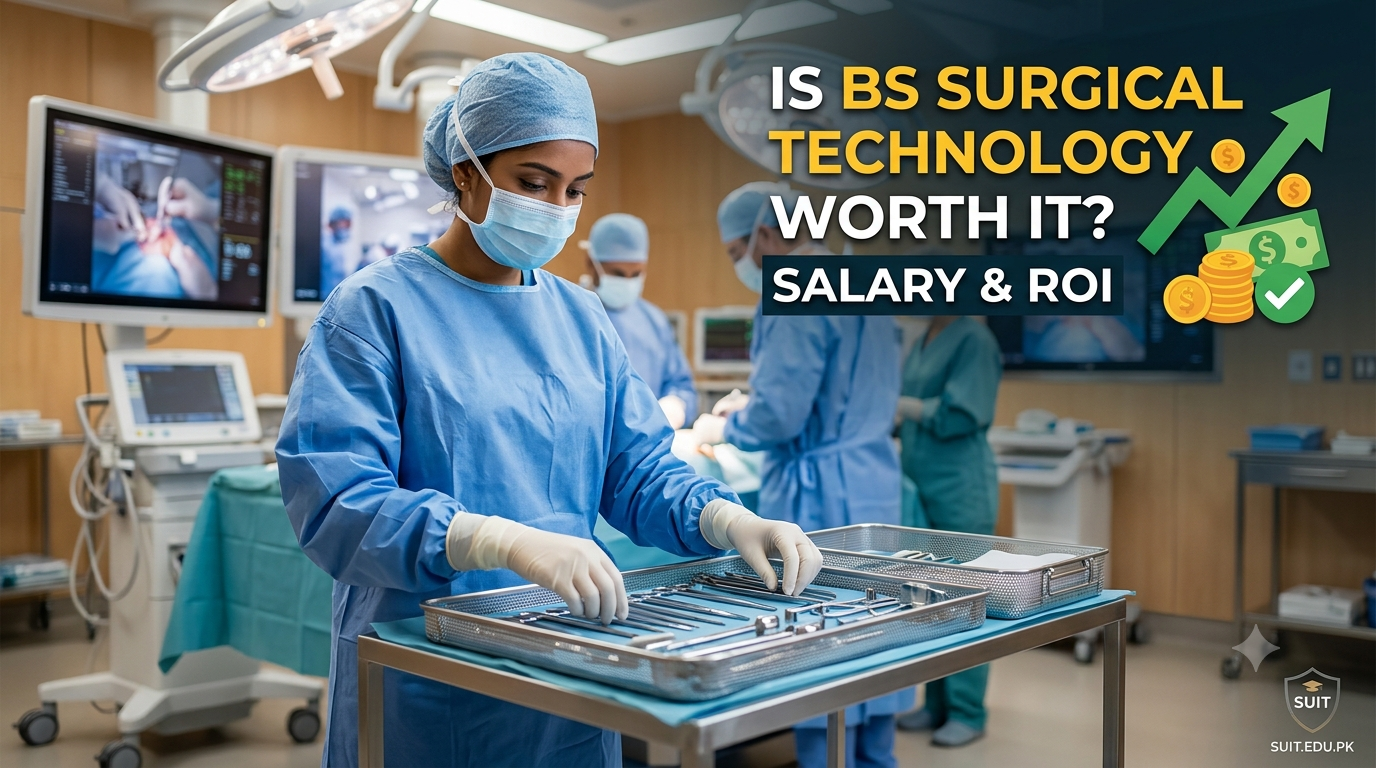
Surgical procedures in Pakistan increased by 22% over the last five years, driving an unprecedented demand for specialized allied health professionals. Operating rooms no longer rely solely on general nursing staff. Modern surgical suites require highly trained technologists to manage complex biomedical equipment, maintain sterile fields, and assist surgeons during critical procedures.
A Bachelor of Science (BS) in Surgical Technology bridges the gap between complex medical theory and high-stakes clinical execution. For students targeting the healthcare sector in Peshawar and Islamabad, this degree offers a direct pathway to stable, high-paying medical careers without completing a full five-year medical degree.
The Strategic Value of a BS in Surgical Technology
Earning a BS in Surgical Technology positions graduates at the center of modern healthcare delivery. Healthcare facilities across Pakistan face a critical shortage of certified technical personnel, making this specialization highly lucrative.
HEC Recognition and Academic Credibility
The Higher Education Commission (HEC) recognizes the four-year BS Surgical Technology program as a professional tier-1 allied health degree. Sarhad University of Science and Information Technology (SUIT), a premier W-Category university, aligns its curriculum with HEC guidelines to ensure nationwide and international degree validity. This W-Category status guarantees that the degree meets the highest quality assurance standards, which simplifies the credential evaluation process for graduates planning to work in the US, UK, or Middle East.
Clinical Competencies and Training
The curriculum combines rigorous academic coursework with intensive clinical rotations. Students master sterile techniques, anesthesia delivery systems, patient preparation, and surgical pharmacology.
Comprehensive Program Structure
| Academic Metric | Detail |
|---|---|
| Program Duration | 4 Years (8 Semesters) |
| Total Credit Hours | 130 – 140 Credit Hours |
| Core Accreditation | HEC Recognized |
| Institutional Category | W-Category University |
| Clinical Internship | Mandatory 12-Month Rotation Included |
Return on Investment (ROI) and Financial Value
Investing in a four-year allied health degree requires a clear understanding of the financial returns. Compared to traditional science degrees, the BS in Surgical Technology offers a rapid transition from graduation to employment.
Fee Structure and Affordability
Tuition fees for allied health programs at SUIT remain competitive with flexible payment options. Financial aid committees review applicants automatically during the admission cycle to minimize out-of-pocket costs. Students can review the breakdown of semester fees, laboratory charges, and registration expenses via the institutional financial portal. Check SUIT BS Allied Health Sciences tuition rates here
Scholarship Eligibility
Academic merit scholarships cut total tuition costs significantly for high-performing students.
- Merit-Based Incentives: Students holding top positions in Board of Intermediate and Secondary Education (BISE) examinations receive up to 100% tuition waivers.
- Kinship and Needy Scholarships: Institutional quotas provide financial relief to underprivileged students and siblings of current enrolled students.
- Provincial Support: Eligible students can leverage government laptop schemes and regional higher education stipends.
Job Prospects and Career Trajectories
Graduates secure employment quickly due to the specialized nature of their skills. The expansion of private hospital networks in Islamabad and public healthcare initiatives in Khyber Pakhtunkhwa ensures a steady stream of job openings.
Primary Employment Sectors
- Government Teaching Hospitals: Class-A public hospitals recruit technologists through provincial public service commissions at Grade 16 and Grade 17 positions.
- Private Corporate Healthcare Networks: Elite facilities in Islamabad offer premium starting salaries for technicians trained in robotic and laparoscopic surgery support.
- Diagnostic and Outpatient Surgery Centers: Specialized clinics hire technologists to manage ambulatory care units and sterilization departments.
Career Pathways and Average Salaries
| Job Title | Expected Starting Salary (PKR/Month) | Mid-Career Salary (5+ Years Experience) |
|---|---|---|
| Operating Room Technologist | PKR 45,000 – 60,000 | PKR 90,000 – 120,000 |
| Sterile Processing Manager | PKR 50,000 – 70,000 | PKR 110,000 – 150,000 |
| Surgical Equipment Consultant | PKR 60,000 – 80,000 | PKR 150,000+ (Plus Commissions) |
| Clinical Instructor / Academic | PKR 55,000 – 75,000 | PKR 130,000 – 180,000 |
Why Choose SUIT for Allied Health Sciences?
SUIT delivers an education that matches international healthcare standards. The university utilizes advanced simulated operating rooms where students practice instrument handling and emergency protocols before entering real-world clinical rotations.
Strategic Location and Clinical Partnerships
Operating from campus facilities accessible to Peshawar and Islamabad, the university maintains partnerships with leading tertiary care hospitals. These clinical affiliations ensure that students complete their mandatory hours under the supervision of senior surgeons and certified healthcare managers. Prospective students can check program specific details and application deadlines on the university admission dashboard. Review the SUIT academic program catalog here
Beyond the Operating Room: Emerging Alternatives
If direct surgical support does not align with your long-term goals, the Faculty of Sciences offers alternative high-demand pathways. Students can pivot toward data-driven healthcare roles or computational science. The field of information technology provides robust analytical avenues that complement health metrics. Explore computing career options to compare entry requirements. View the SUIT BS Computer Science program details here
Frequently Asked Questions (FAQs)
Is a BS in Surgical Technology recognized by the Pakistan Medical and Dental Council (PMDC)?
The BS in Surgical Technology is an allied health degree regulated by the Higher Education Commission and the National Council for Allied Health Professionals rather than the PMDC. PMDC regulates MBBS and BDS practitioners exclusively, while allied health professionals operate under distinct national qualification frameworks.
Can graduates of this program work in international hospitals?
Graduates qualify for international employment after passing regional licensing examinations such as the DHA in Dubai or completing credential evaluations for US healthcare boards. The W-Category status of the university ensures the degree satisfies international academic equivalence checks.
What is the difference between a surgical technologist and an operating room nurse?
Surgical technologists focus primarily on sterile field management, surgical instrumentation, and technical room preparation before and during surgery. Operating room nurses handle broader patient care duties, pre-operative assessments, and post-anesthesia recovery monitoring.
What are the admission criteria for the BS Surgical Technology program?
Applicants must possess an FSc Pre-Medical or an equivalent qualification with a minimum of 50% marks from a recognized board. Admissions depend on academic merit lists calculated from matriculation and intermediate results. Candidates can initiate their applications through the digital registration system. Apply online through the SUIT admission portal here