
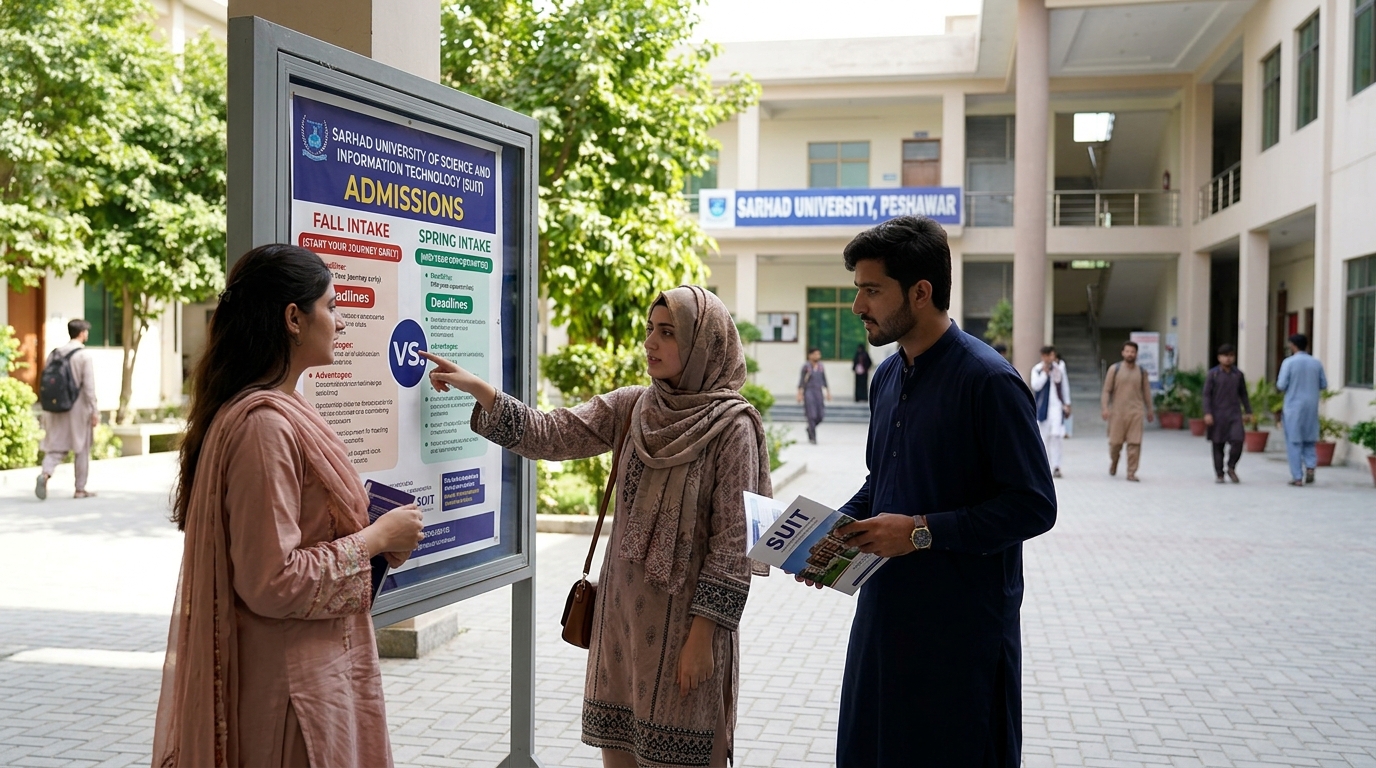
Higher education admission metrics reveal that 70% of academic program seats in Pakistan are allocated during Fall intakes, making enrollment timing a crucial factor for long-term career progression.
Comparative Breakdown: Fall vs. Spring Academic Intakes
Pakistani higher education institutions operate on a dual-semester academic calendar. Selecting between Fall and Spring admission cycles requires evaluating class capacities, program availability, and prospective graduation timelines.
| Selection Metric | Fall Intake (August / September) | Spring Intake (January / February) |
|---|---|---|
| Seat Allocation Share | 70% of total annual seats | 30% of total annual seats |
| Program Availability | All undergraduate and graduate programs | Select technical, management, and social sciences |
| Scholarship Funding Pool | 100% initial budget distribution | Remaining balance from Fall allocation |
| Corporate Recruitment Alignment | High (Matches annual hiring cycles) | Moderate (Requires off-cycle placement) |
| Prerequisite Sequence Risk | Minimal (Standard sequence) | Moderate (Potential term shifts) |
Academic Accreditation and Program Availability at SUIT
Sarhad University of Science and Information Technology (SUIT), a top W-Category institution chartered by the Government of Khyber Pakhtunkhwa and recognized by the Higher Education Commission (HEC), enforces rigorous academic standards across all departments. Engineering degrees offered by the institution maintain accreditation from the Pakistan Engineering Council (PEC), guaranteeing degree equivalence across domestic and international jurisdictions.
Fall semesters host the full roster of academic programs across the Peshawar and Islamabad campuses. Primary cohorts for BS Computer Science, BS Software Engineering, Civil Engineering, Electrical Engineering, and Allied Health Sciences launch during the August-September intake. Spring admissions, conducted in January and February, accommodate secondary cohorts and fill remaining departmental capacities.
Prospective students can check HEC and PEC accredited programs to review specific academic department offerings prior to applying.
Scholarship Eligibility and Financial ROI
Return on investment (ROI) calculations depend heavily on securing institutional financial support early in the academic life cycle. Institutional funding committees distribute the primary portion of merit-based and need-based scholarships during the Fall application window.
Fall applicants compete for freshly allocated institutional funding, yielding higher average award amounts per recipient. Spring applicants access remaining scholarship reserves, which limits the overall number of grants awarded.
Graduating on a standard Fall cycle accelerates entry into the professional labor market. Swift employment entry ensures a faster return on capital invested in tuition and academic resources.
Students should examine SUIT fee structure and payment plans alongside available merit metrics to optimize total educational expenditures.
Career Alignment and Graduation Timelines
Graduation timing directly impacts job placement rates in competitive corporate, engineering, and technology sectors. Major corporate recruiters and multinational software firms schedule their primary management trainee programs to align with summer graduation cohorts.
Fall intake students complete final degree requirements during spring terms, graduating precisely as corporate recruitment drives open. Spring intake students complete credit requirements during winter terms, often creating a six-month waiting period before major industry recruitment drives commence.
Candidates ready to begin enrollment can review the complete SUIT admission process to ensure deadline compliance. Securing early registration requires prospective applicants to explore available SUIT scholarship programs before department quotas close.
Frequently Asked Questions
Which intake is better for engineering and computer science programs in Pakistan?
Fall intake provides higher seat quotas, full course sequences, and direct alignment with corporate recruitment schedules in Pakistan. Starting technical degrees in Fall prevents prerequisite delays in multi-tiered engineering curricula.
Can students apply for spring admission if they miss the fall deadline?
Spring admission offers a viable entry pathway for students completing late entry exams or delayed prerequisite documentation. Utilizing Spring intake prevents the loss of an entire academic year.
Does HEC recognize degrees completed starting in the spring semester?
Higher Education Commission rules grant identical degree recognition to students graduating from either Fall or Spring admission cycles. Academic transcripts issued by accredited universities like SUIT maintain full validity regardless of starting terms.
Are scholarships available during the spring intake at SUIT?
Merit scholarships remain accessible during Spring admissions, though total available funding pools are smaller than Fall allocations. High-scoring applicants still receive fee concessions based on standardized academic performance metrics.